From pilots to pipelines: Unlocking finance to scale up Nature-based Solutions
17 November 2026
At UNFCCC COP31, the ENACT Partnership, the Government of the Netherlands and UNIDO brought together governments, international organisations and finance experts to explore how to turn Nature-based Solutions from promising initiatives into investable projects that deliver impact at scale.
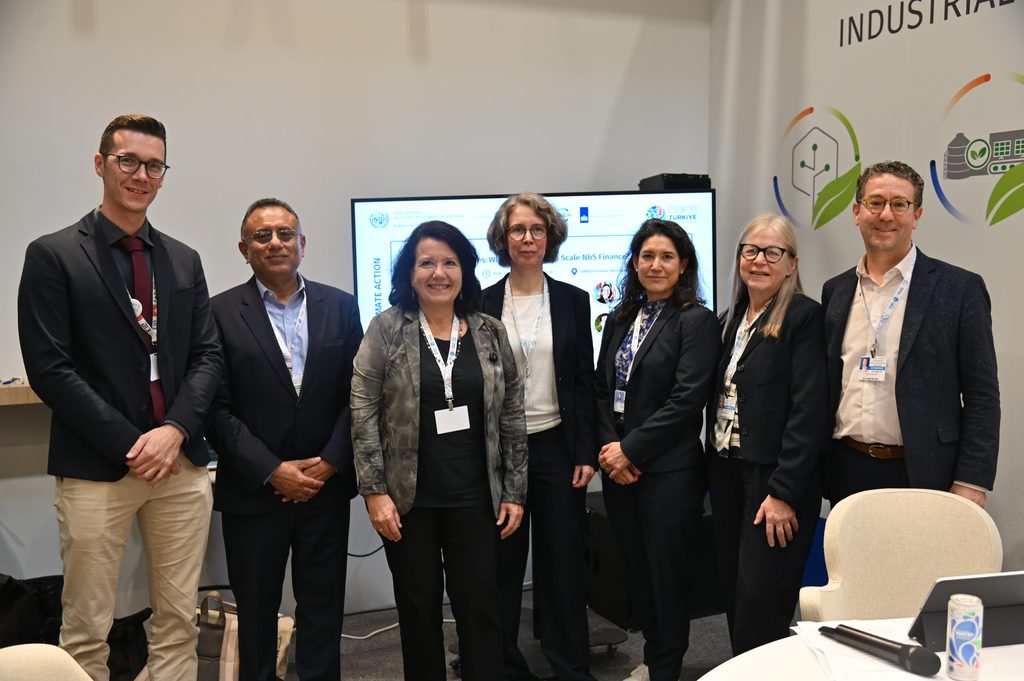
From left to right: Oliver Wolf, Swiss Federal Office for the Environment; Ali Raza Rizvi, IUCN; Afke van Rijn, Government of the Netherlands; Mechthild Caspers, Government of Germany; Maria Ana Petrera, Government of Denmark; Sylvia Wisniwski, Finance in Motion; and Karim ould Chih, UNIDO.
“Our economies are fundamentally dependent on nature, and Nature-based Solutions offer a powerful means of addressing climate change while delivering broader societal benefits,” said Afke van Rijn, Vice Minister for the Environment and International Affairs at the Government of the Netherlands, opening the discussion. “The challenge now is to move beyond individual projects towards system-level, landscape-scale approaches that integrate nature into development planning.”
The message set the tone for a technical side event held at the UNIDO Pavilion during COP31. Co-hosted by the Government of the Netherlands, the United Nations Industrial Development Organization (UNIDO) and the ENACT Partnership, the event examined the financial, institutional and practical barriers preventing promising Nature-based Solutions (NbS) initiatives from reaching scale.
As Ali Raza Rizvi, Director of IUCN’s Global Climate Change & Energy Transition Team and moderator of the session, highlighted, “Global investment in Nature-based Solutions currently stands at around US$220 billion annually, yet estimated financing needs reach US$571 billion per year to meet global biodiversity, climate and land restoration targets. With approximately 90% of current funding coming from public sources, there remains a significant opportunity to mobilise private capital and scale investment at the pace required.”
From policy ambition to investable projects
Building on the ENACT Partner Dialogue on Innovative Financing for Nature-based Solutions held in July 2026, speakers explored a central finding: the main bottleneck is often not a lack of NbS strategies or pilot initiatives, but the difficulty of turning these into commercially viable, investment-ready projects.
Mechthild Caspers, Head of Division for Climate Policy in the Land Sector and Nature Restoration at Germany’s Federal Ministry for the Environment, Climate Action, Nature Conservation and Nuclear Safety (BMUKN), highlighted the role of ENACT in bridging this gap. By bringing state and non-state partners together and aligning their efforts, the Partnership can help move beyond fragmented initiatives towards more coordinated, large-scale and long-term implementation.
Switzerland’s experience offered practical lessons on creating the conditions for this transition. Oliver Wolf, Forest Policy Advisor at the Swiss Federal Office for the Environment, emphasised the importance of strong governance, integrated policies and credible impact measurement. Examples such as the Biodiversity Action Plan, integrated forest management and seed funding for urban tree planting demonstrate how targeted public investment and locally tested approaches can create the foundations for wider uptake. Testing innovative approaches at the cantonal level, he noted, can also provide a pathway for scaling successful models nationally.

Making nature investment-ready
While public finance remains critical for early-stage development and reducing investment risks, attracting private capital requires a different approach to how NbS projects are designed and presented.
Sylvia Wisniwski, Chief Executive Officer of Finance in Motion, stressed that project developers need to understand the perspective of investors. Institutional investors may not be familiar with the term NbS, but they do understand investment structures, asset classes, risk profiles and returns. To attract their interest, NbS projects need to demonstrate financial viability, replicability, a track record and clear exit strategies.
In response to this, Karim ould Chih, Chief of the Division of Innovative Finance and International Financial Institutions at UNIDO, underlined that there is a “need to connect policy ambition with project preparation, public support with appropriate private investment, and credible measurement with practical delivery, to mobilize finance at scale for NbS.”
The discussion also highlighted the need to strengthen national planning and enabling conditions. Integrating NbS into Nationally Determined Contributions (NDCs), National Adaptation Plans (NAPs), National Biodiversity Strategies and Action Plans (NBSAPs) and wider development strategies can help provide the policy coherence and long-term certainty needed to encourage investment.
No single financing model
Closing the discussion, Maria Ana Petrera, Head of Team Global Climate and Energy Policy at Denmark’s Ministry of Foreign Affairs, highlighted that although the concepts and policy frameworks for NbS are increasingly established, making projects attractive and viable investments remains a key challenge.
“There is no single financing model that will unlock NbS at scale,” she noted. Progress will depend on piloting different approaches, testing a range of financial mechanisms and learning from implementation to identify solutions suited to different contexts.
Marina Ponti, Deputy to the Director General and Managing Director of UNIDO’s Directorate of SDG Innovation and Economic Transformation, reinforced the importance of connecting policy, partnerships and finance to deliver tangible outcomes: “Clear policies, strong partnerships and accessible finance turn climate commitments into decent jobs and inclusive and sustainable development for people and the planet.’’
The event reinforced a shared message: scaling up NbS finance will require more than new funding sources. It calls for stronger national enabling environments, better-prepared project pipelines, innovative public-private financing approaches and harmonised monitoring, reporting and verification systems that build confidence in the results.
Through continued collaboration and knowledge exchange, the ENACT Partnership and its partners aim to help bridge the gap between ambition and implementation – ensuring that NbS can move beyond isolated pilots to deliver lasting benefits for climate, nature and people.