
Ulaanbaatar, Mongolia, August 20, 2026 – At the seventeenth session of the Conference of the Parties to the United Nations Convention to Combat Desertification (UNCCD COP17), the Ulaanbaatar Technical Dialogue on Rio Synergies expanded on the Antalya Dialogue convened in May, advancing the conversation from the strategic case for land as common ground towards the practical substance of implementation. Countries and technical partners examined what is already working on the ground, what could be taken further, where implementation gaps remain and what support partners and existing initiatives can provide.
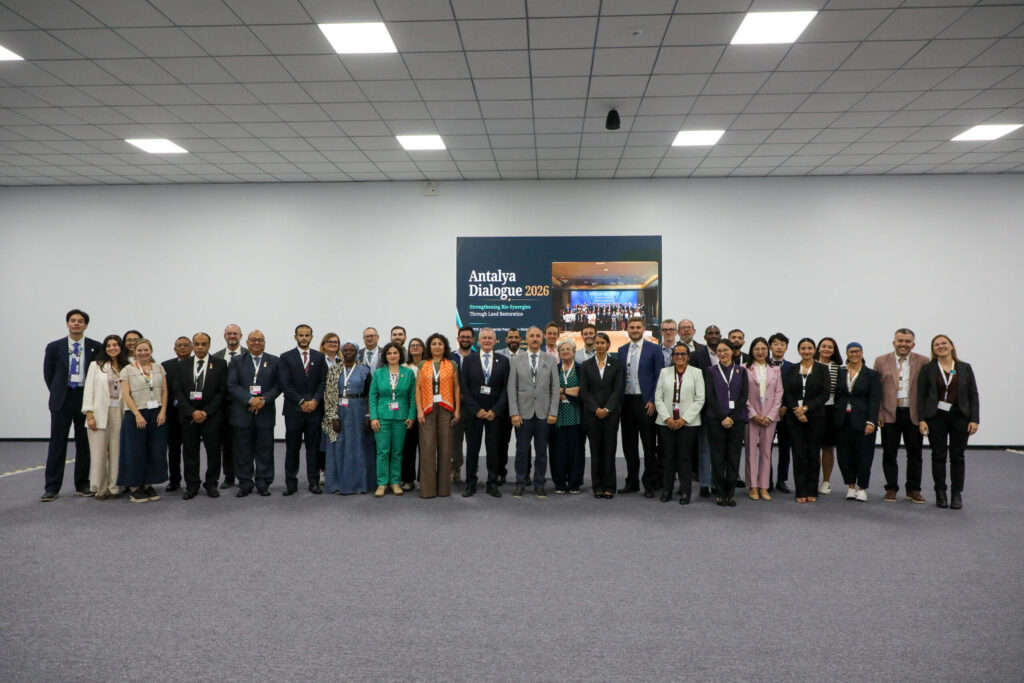
The Ulaanbaatar discussion reinforced a central message from Antalya: the priority now is to shift the discourse on the synergies on land, biodiversity and climate from ambition to action. This means putting national priorities and implementation needs at the centre and making better use of the expertise, partnerships and resources that already exist.
Convened by the Türkiye COP31 Presidency, the G20 Global Land Initiative and the ENACT Partnership hosted by IUCN, the dialogue brought together representatives from countries and technical partners to identify practical pathways for more coherent, country-led implementation.
Held under the theme “Land as the Common Ground,” the Ulaanbaatar Technical Dialogue continued the conversation initiated in Antalya, with consecutive dialogues to be held at the UN Biodiversity Conference in Yerevan (CBD COP17) and the UN Climate Conference in Antalya (UNFCCC COP31). The dialogues will culminate in the launch of the Rio Synergies Group for Action under the COP31 Presidency Action Agenda.

Moving beyond the language of synergies
Chair of the dialogue, Stewart Maginnis, Deputy Director General of IUCN, opened by stressing that the test of the effectiveness of land, biodiversity and climate synergies is whether global commitments can translate into coherent policies, investments and action at national and local levels.
“We want to understand what is working, what countries can build on, where the implementation gaps remain, and what is needed to overcome them.“
Land restoration and Nature-based Solutions (NbS), he noted, can provide practical entry points for bringing these agendas together.
“Connect what already exists”
Representing the COP31 Presidency, Prof. Dr. Kasım Yenigün, Türkiye’s UNCCD National Focal Point, stressed that countries already have extensive commitments and frameworks contributing to the three Rio Conventions.
The priority, he explained, is not to create new obligations, reporting burdens or institutional structures, but to connect what already exists and turn synergy into implementation.
This is at the heart of Türkiye’s proposed Rio Synergies Group for Action, which aims to bring countries together around voluntary country-driven actions ahead of COP31.
The COP31 Presidency called on countries to identify areas where climate, biodiversity and land objectives can be advanced together and to develop concrete National Flagship Actions based on their existing commitments and national circumstances.
International organisations and technical partners, meanwhile, have a role to play in bringing together expertise, methodologies and capacity-building, while financial institutions and development partners can help turn integrated solutions into investable action. As Prof. Dr. Yenigün put it: “Join us with action.”
“Our ambition for COP31 is clear: to move Rio Synergies from dialogue to implementation, from separate commitments to synergistic action, and from ambition to remarkable results.”
Building on existing platforms
Muralee Thummarukudy, Director of the G20 Global Land Initiative hosted at UNCCD, connected the Ulaanbaatar Technical Dialogue to the Strategic Antalya Dialogue held in May 2026.
The Antalya Dialogue brought together G20 countries, Rio Convention COP Presidencies and secretariats, international organizations and technical partners. Its central message was that Rio synergies need to move from ambition to action by putting country priorities and implementation needs at the centre.
The Antalya discussions had already highlighted a key message, that countries and partners need to make better use of existing institutions, platforms and initiatives and strengthen their connections.
The G20 Global Land Initiative has provided a platform for this work, bringing together countries and implementation partners and helping connect the Rio synergies discussion with existing expertise, partnerships and resources.
For Thummarukudy, the Ulaanbaatar Technical Dialogue was an opportunity to move from broad discussions to the substance of implementation: identifying what is working, what can be scaled, where gaps remain and what support is available.
Land offers a particularly practical starting point. “Land is where climate, biodiversity, food, water, livelihoods and resilience come together”, said Thummarukudy.
The dialogue therefore reinforced the potential of land restoration as a common entry point for integrated action across the three Rio Conventions.

What does synergy look like in practice?
Listening to the interventions from 23 countries and the EU, a common set of priorities and implementation challenges emerged.
1. Start with existing national processes
Countries highlighted that many of the building blocks for integrated action are already in place. Nationally Determined Contribution (NDCs), National Biodiversity Strategy and Action Plans (NBSAPs), Land Degradation Neutrality (LDN) targets, National Adaptation Plans (NAPs), restoration strategies, drought plans and other national instruments can provide entry points for bringing coherence to climate, biodiversity and land priorities.
The challenge is to strengthen coherence among these processes rather than create parallel ones. Several interventions highlighted the value of whole-of-government and multi-level approaches, including stronger coordination among national focal points and across ministries, sectors and levels of government and governance.
2. Build bridges, not new silos
A recurring message was that having institutions in place does not automatically create synergy.
Countries called for stronger coordination among existing institutions, better information sharing and practical approaches to overcoming fragmentation, while respecting the distinct mandates of each Rio Convention. This could include stronger national coordination mechanisms, shared technical frameworks, common terminology and better links between planning, implementation, monitoring and reporting.
3. Put land restoration at the centre of integrated action
Restoring degraded landscapes can simultaneously contribute to biodiversity conservation, climate adaptation and resilience, drought management, food and water security, and livelihoods.
Participants highlighted the importance of moving beyond treating land in isolation and considering its connections with climate, water, forests, food systems, agriculture, rangelands and wider ecosystems.
Landscape approaches and NbS can provide frameworks for bringing these interconnected priorities and stakeholders together.
Several Parties pointed to the ENACT Partnership as an important vehicle for translating Rio Convention synergies into implementation through NbS. As an existing platform focused on accelerating NbS across climate, biodiversity and land restoration, ENACT can help connect country priorities with knowledge, partnerships, capacity and investment needed to move integrated solutions from policy ambition to action on the ground.

4. Align policies, investments and action
Participants repeatedly pointed to a gap between national commitments and the financing and implementation systems needed to deliver them.
Fragmented financing can reinforce fragmented implementation. Countries therefore called for stronger coherence between national priorities and international finance, alongside greater use of blended finance, public-private investment and existing financing mechanisms.
The discussion also highlighted the importance of making integrated solutions bankable and investable, while ensuring that financing responds to nationally identified priorities.
5. Make monitoring and reporting work across agendas
Better use of data emerged as another pathway to implementation, with countries highlighting opportunities to harmonise indicators, connect monitoring systems and use nationally validated data to track multiple environmental objectives and targets.
More coherent monitoring and reporting could help to minimise the reporting burden while providing a clearer picture of the combined benefits of integrated interventions.
Practical guidance and methodologies are also needed to identify where priorities overlap to avoid duplication and to measure the multiple benefits generated by action across climate, biodiversity and land.
6. Put people and communities at the centre
Indigenous Peoples, local communities, youth, civil society, academia and other stakeholders need to be meaningfully involved throughout planning and implementation—not simply consulted at the end.
Participants emphasised the importance of local knowledge, community ownership and inclusive governance, alongside approaches that recognise the rights and contributions of those managing landscapes on the ground.
This also means ensuring that gender considerations are integrated into climate, land and biodiversity action.
From commitments to country-led action
Across the interventions, a consistent message emerged: synergies need to become visible in policies, investments and action on the ground.
This means identifying practical opportunities where different objectives can be pursued together—from ecosystem restoration and drought resilience to sustainable agriculture, forestry, wetlands, renewable energy and sustainable food systems.
It also means recognising that countries will take different pathways depending on their national circumstances.
The proposed Rio Synergies Group for Action aims to support precisely this country-led approach, creating a space where countries can bring forward concrete actions and connect them with the technical expertise, partnerships and finance needed for implementation.
From Antalya through the triple COP Year and beyond
The Ulaanbaatar Technical Dialogue built on the journey initiated in Antalya and carried the conversation into the 2026 triple COP year.
The dialogue series will continue at CBD COP17 in Yerevan, where the focus on “Nature as the Integrator” will bring biodiversity conservation, ecosystem restoration and NbS deeper into the synergies agenda. The process will then proceed to UNFCCC COP31 in Antalya, with a focus on “Climate as the Accelerator”, strengthening coherence across policy, investment and action.
While the immediate journey leads through Yerevan to COP31 in Antalya, the longer-term objective is to sustain cooperation beyond 2026 by encouraging continuity among future Rio Convention COP Presidencies and maintaining a shared focus on country-led integrated implementation.
Summarising the discussion and outlining the next steps, Ali Raza Rizvi, Director, Climate Change and Energy Transition at IUCN, stressed that this is not about creating a new initiative or adding another institutional layer. Rather, it is about supporting the proposed voluntary country-led Rio Synergies Group for Action where each country will determine how best to transform this discourse into tangible action on the ground.
He highlighted knowledge sharing, capacity building, institutional strengthening and inclusive processes as essential to making that transition possible. Delivering synergies in practice will also require greater coherence across policy, investment and action, so that efforts under the three Rio Conventions reinforce one another where and when implementation actually takes place.
With the dialogue continuing in Yerevan and then Antalya, Rizvi emphasised that the way forward will be shaped collectively by Parties and partners, building on existing institutions, knowledge and initiatives rather than starting anew. “We look forward to working with you all,” he concluded.
As Stewart Maginnis underscored, the task is to ensure that countries and partners are doing “the right things, in the right places, with the right partners” to make land, biodiversity and climate synergies work in practice.
À propos du partenariat ENACT
Le Partenariat ENACT, co-led by the Governments of Egypt and Germany, supported by the Government of Denmark, and coordinated by IUCN, is a global coalition of 27 governments and global non-state partners working to accelerate NbS for climate, biodiversity, and land restoration. ENACT supports the COP28 Joint Statement on Climate, Nature and People and contributes directly to the Global Climate Action Agenda by fostering collaboration, aligning finance, and scaling implementation of NbS worldwide.
About the G20 Global Land Initiative
The G20 Global Land Initiative was launched by G20 Leaders in 2020 under the Saudi Arabia G20 Presidency and is hosted by the United Nations Convention to Combat Desertification (UNCCD). Its ambition is to achieve a 50 per cent reduction in degraded land by 2040.
The Initiative brings together people, ideas and resources to protect healthy land and restore degraded land worldwide. Working across policy and implementation, it supports political dialogue, policy coherence, knowledge sharing and partnerships that help translate commitments on land restoration into practical action and scale up sustainable land management globally.
About COP31 Türkiye
Türkiye will host UNFCCC COP31 in Antalya, 9–20 November 2026, as a turning point for climate action. Shaped as the “COP of the Future,” COP31 aims to move climate action beyond promises and commitments towards a new era of verified, measurable and sustainable implementation on the ground.
Grounded in the principle that “commitment is a declaration of intent, but implementation is trust,” the COP31 vision is built around three pillars: rebuilding trust through dialogue, strengthening shared responsibility through consensus, and turning commitments into action on the ground. These principles are reflected in the COP31 Action Agenda, which brings together priority areas for accelerated and inclusive implementation.
Within this framework, Rio Synergy is a key priority, recognising that climate change, biodiversity loss and land degradation are interconnected challenges requiring integrated solutions. It seeks to strengthen cooperation across the UNFCCC, CBD and UNCCD, connect existing commitments such as NDCs, NBSAPs and LDN targets, and translate them into practical action on ecosystem restoration, sustainable land management, carbon sinks, wildfire resilience and NbS.