ENACTing commitments: Scaling Nature-based Solutions across land, climate and biodiversity agendas at UNCCD COP17
27 août 2026
Ulaanbaatar, Mongolia, 25 August 2026 — As countries look for practical ways to accelerate action across the three Rio Conventions, a high-level dialogue at the 17th session of the Conference of the Parties (COP17) to the United Nations Convention to Combat Desertification (UNCCD), brought together governments, Convention representatives, development partners and Nature-based Solutions (NbS) experts to explore how integrated approaches can move from commitments to implementation.
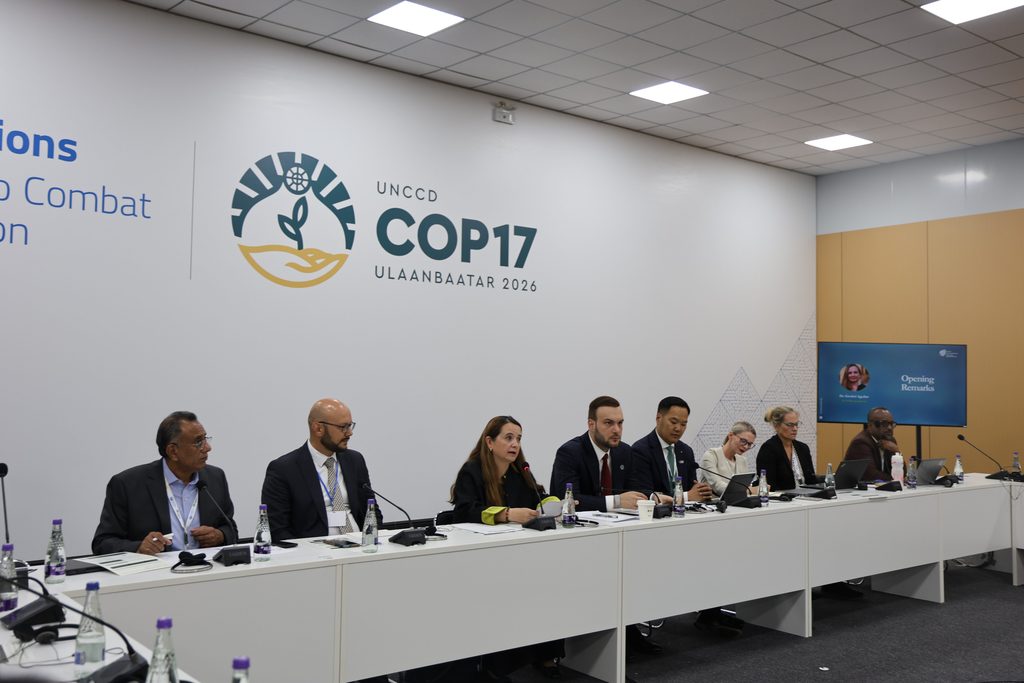
Co-hosted by the UNCCD COP17 Presidency and the ENACT Partnership, the dialogue, ‘Transformation for Land, Climate and Biodiversity Resilience through Nature-based Solutions’, focused on a central question: how can countries better connect land restoration, climate action and biodiversity conservation through coherent policy, finance and implementation?
Across the discussion, one message emerged clearly: the opportunity is no longer simply to recognise the potential of NbS, but to create the conditions needed to implement and finance them at scale.

Nature as a foundation for climate action
Opening the dialogue, Munkhtamir Batbayar, Vice Minister of Environment and Climate Change of Mongolia, highlighted Mongolia’s efforts to advance NbS and Rio synergies, encouraging partners to engage with the country’s initiatives.
“NbS is a cross-cutting theme that can connect action across the Rio Conventions.”
His remarks reflected Mongolia’s broader focus at COP17 on land restoration, climate resilience and sustainable infrastructure, including through the Nature-based Solutions for Sustainable Infrastructure Initiative (NbS4SII) and related initiatives under the Steppe Action Agenda.

Opening on behalf of the ENACT Partnership and IUCN, Dr. Grethel Aguilar, Director General of IUCN, highlighted the growing momentum around Rio synergies and ENACT’s role in connecting climate, biodiversity and land through Nature-based Solutions.
She emphasised that “land restoration is the bridge between the Rio Conventions,” delivering benefits for climate, biodiversity, water resilience and sustainable development.
“What ENACT brings to the table, amongst the plethora of synergy initiatives, is the focus on Nature-based Solutions,” Dr. Aguilar said, highlighting the Partnership’s role, now bringing 27 state and non-state partners to the table, in translating synergies into aligned policies, investments and action on the ground.
Building on this work, ENACT partnered with the Türkiye COP31 Presidency to convene the Ulaanbaatar Technical Dialogue on Rio Synergies at COP17, which builds on the Antalya Dialogue held last May, bringing countries together to share practical experiences and identify pathways for greater coherence. ENACT will continue engaging with partners across the Convention on Biological Diversity (CBD) and United Nations Framework Convention on Climate Change (UNFCCC) COPs to carry this momentum forward towards COP31 and beyond.
The dialogue comes at a critical moment. Land degradation, climate change and biodiversity loss are deeply interconnected, affecting the same landscapes and communities. NbS can help bring these agendas together, but only when supported by coherent policies, financing and implementation systems.

From Rio synergies to implementation
Representing the UNFCCC COP31 Presidency, Dr. Cemal Baş, Head of the International Organizations Section of the Türkiye COP31 Presidency Office, reflected on the outcomes of the Ulaanbaatar Technical Dialogue on Rio Convention synergies held earlier during COP17.
He highlighted the importance of stronger institutional collaboration and confirmed that Rio synergies are a priority within the COP31 Action Agenda.
“We need stronger collaboration among our institutions.”
With COP31 approaching in Antalya, Baş also stressed the importance of listening to perspectives from countries and communities and ensuring that the synergies agenda supports implementation rather than remaining confined to negotiations.

The message was reinforced by Samed Ağırbaş, COP31 High-Level Champion, who called on partners to use NbS to translate ambition into implementation and stressed that restoring nature must be treated as an integral part of climate action.
“There is no climate transition without nature. Land systems are fundamental to catalysing action against the climate crisis.”

New evidence on the state of Nature-based Solutions
The dialogue also provided an early look at findings from the ENACT Partnership’s forthcoming NbS report, presented by Enni Kallio, Programme Officer at IUCN.
The report, which will be officially launched at UNFCCC COP31, provides a first-of-its-kind global assessment of how NbS are being incorporated into national planning instruments under the Rio Conventions. Using an AI-assisted assessment framework, it analyses policy documents from 127 countries, examining the presence and depth of NbS integration across land, climate and biodiversity policies.
The early findings show that NbS are increasingly referenced in national policies, but significant implementation gaps remain. In particular, the scale of policy ambition is not yet matched by the financing and implementation capacities required to meet it.
Moreover, Land Degradation Neutrality (LDN) emerges as an important entry point for connecting land, climate and biodiversity objectives. Yet despite this potential, land remains comparatively underrepresented as a linkage across the national policy documents assessed.
The report also highlights that policy coherence alone is not enough. Stronger institutional coordination aligned investments and systems for monitoring implementation are needed if NbS are to deliver simultaneous benefits for land restoration, climate action and biodiversity.
The fundamental message from the report is therefore one of moving from policy pledges to implementation: helping countries translate existing NbS commitments into financed, measurable and monitored action.

Turning synergies into investment opportunities
The need for finance was a recurring theme throughout the discussion.
Xenya Scanlon, Chief of Communication, External Relations and Partnerships at the UNCCD Secretariat, and Sherpa of the Joint Liason Group, highlighted the scale of the challenge, noting that there is an estimated USD 278 billion annual financing gap for combating desertification, land degradation and drought.
But, she stressed, the conversation should not focus only on the gap.
There are also significant investment opportunities, particularly in landscapes such as rangelands, which sit at the intersection of desertification, drought, biodiversity, climate change and livelihoods.
For UNCCD, synergies are fundamental because, as Scanlon noted, “everything is connected to land.” She thanked the Presidencies for championing the synergies agenda and highlighted the Action Agenda as an important opportunity to carry this work forward and make it meaningful at the national level.
The discussion reinforced that scaling NbS will require more than additional funding: it will require stronger investment cases, better alignment between financing streams and approaches that demonstrate multiple benefits across environmental and development priorities.

Understanding context before scaling solutions
The partner discussion, moderated by Ali Raza Rizvi, Director of the Climate Change and Energy Transition Team at IUCN, brought these questions down to the national and institutional level, examining how countries and international organisations can address practical barriers to expanding NbS implementation.

Dr. Eman ElSherif, Desert Research Center, represented Egypt’s perspective on advancing Rio synergies through NbS. Egypt, as Co-Chair of the ENACT Partnership alongside Germany, reaffirmed its support for bringing land, biodiversity and climate action together and called for countries and partners to join the collective effort. “We need volume and action at scale, because without that, each project, each initiative, is just another drop of water on a hot stone.”
The discussion also highlighted the importance of moving beyond individual projects towards action at scale — recognising that isolated initiatives cannot deliver the transformation required across landscapes and economies.

Melissa de Kock, Deputy Director of UNEP-WCMC, put forward an important reminder about how this work should be approached: international partners need to understand local and national contexts rather than assuming that existing solutions can simply be transferred elsewhere.
She also highlighted the importance of communicating both successes and failures. Sharing evidence of what works — and what does not — can help build confidence and make it easier to mobilise financing for NbS.
From Ethiopia to the global agenda
Closing the dialogue, Dr. Teshome Tamirat of the Ethiopian government and UNCCD National Focal Point highlighted Ethiopia’s interest in joining the global ENACT Partnership and its experience using landscape-scale approaches to build resilience.
He emphasised the potential of NbS to connect implementation across the three Rio Conventions, noting that restoring degraded landscapes can simultaneously support land restoration, biodiversity conservation and climate adaptation.
Ethiopia’s Green Legacy Initiative, alongside watershed management, restoration and agroforestry efforts, provides an example of how landscape-level adaptation can respond to recurrent drought, soil erosion and wider climate impacts while supporting food, water and ecosystem services.
Looking ahead to Ethiopia hosting UNFCCC COP32 in Addis Ababa in 2027, Dr. Tamirat positioned the opportunity as a chance to elevate an African-led, action-oriented adaptation agenda, with grassroots adaptation, scaled climate finance and NbS at its centre.
From alignment to delivery
Across the dialogue, a common picture was revealed: Rio synergies are increasingly recognised, but their success will ultimately depend on whether they change policies, investments and action on the ground.
NbS can provide a practical bridge between the three Rio Conventions, but their potential will only be realised if countries have the institutional coordination, evidence, finance and partnerships needed to implement them.
The ENACT Partnership’s forthcoming 2026 Report will contribute to this effort by identifying where countries are already integrating NbS into national frameworks, where gaps remain, and where further action can help turn commitments into results.
As the triple COP year moves towards COP31 in Antalya, the challenge is to build on the momentum in Ulaanbaatar, that started in Antalya and is moving towards Yerevan and Antalya again, and create the conditions for coherent policies, aligned investments and action at the scale required to restore land, strengthen climate resilience and conserve biodiversity.
The message is clear: nature can connect the agendas. The next step is connecting that ambition to coherent policy, investment and action.